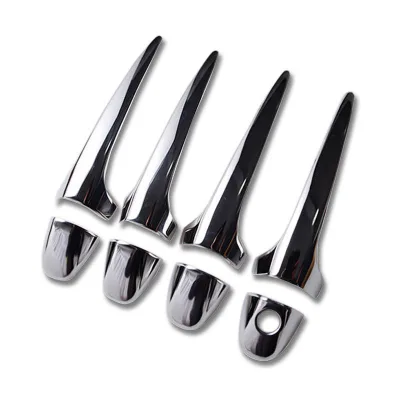
Source decorative car door handle for SUVs, Sedans, and Trucks
Compare 30 listings for decorative car door handle options featuring ABS materials and custom packaging. Buyers can evaluate models like 203012 and 203005 with OEM services and lead times ranging from 10 to 35 days; compare the available evidence and request quotations based on your requirements.
Key considerations
Products List




Comprehensive Sourcing Guide
Decorative Car Door Handle Sourcing Guide
Sourcing decorative car door handles requires a strategic balance between aesthetic customization and functional durability. Buyers must navigate a market where materials like ABS plastic dominate, offering a cost-effective solution for universal fitment across various vehicle makes. The observed product landscape indicates a strong emphasis on OEM and ODM services, allowing brands to integrate custom logos and packaging designs. This flexibility is crucial for companies looking to differentiate their aftermarket accessories while maintaining consistent quality standards.
The procurement process involves verifying specific technical attributes, such as the center muffler type and door handle positioning, which may seem unrelated but often indicate the supplier’s broader manufacturing capabilities in automotive components. Understanding these nuances helps buyers assess whether a supplier specializes in interior trim or general machinery parts. By focusing on suppliers with established injection molding and CNC machining processes, purchasers can ensure that the decorative elements meet precise dimensional tolerances and surface finish requirements.
Product Scope and Observed Listing Signals
The current market for decorative car door handles features a wide range of models, including specific identifiers like 203012, 203005, and 203011, which suggest a diverse inventory catering to different vehicle aesthetics. Listings frequently highlight ABS material construction, which provides a lightweight yet durable option for exterior trim applications. The presence of universal car make compatibility indicates that these handles are designed for broad market appeal, allowing retailers to stock fewer SKUs while serving a larger customer base. This universality is a key selling point for buyers seeking to minimize inventory complexity.
Packaging variations are another significant signal, with options ranging from blister packs to color boxes and bulk poly bags. These differences often correlate with the target market segment, where premium finishes require more protective and visually appealing packaging. The observed single package size of 40x30x20 cm and a gross weight of 2.000 kg provide critical data for logistics planning. Buyers should use these metrics to calculate landed costs accurately, ensuring that shipping expenses do not erode profit margins, especially when importing from manufacturing hubs like Zhejiang, China.
Technical Specifications to Verify
Verifying the material composition is paramount, as ABS plastic is the primary material cited in listings, offering good impact resistance and ease of molding into complex shapes. Buyers must confirm that the ABS grade used meets specific UV resistance and temperature tolerance standards to prevent fading or cracking under prolonged sun exposure. Additionally, the surface preparation processes, such as polishing, play a vital role in the final aesthetic quality. Ensuring that the surface finish is consistent across all units in a batch prevents visual defects that could lead to customer returns or brand damage.
Tolerance grades and machining precision are equally important for ensuring a proper fit on various door handles. The mention of a tolerance grade of 6 suggests a specific level of manufacturing precision that buyers should validate through sample testing. Furthermore, the availability of prototype processes like SLA, vacuum forming, and CNC machining indicates that suppliers can support rapid iteration and custom design development. Buyers should request detailed technical drawings and dimensional reports to verify that the handles align with their specific vehicle models before committing to large production runs.
Compliance and Safety Documentation
While decorative handles are primarily aesthetic, they must comply with general safety and quality management standards. The reference to ISO 9001 certification in the context of casting surface quality highlights the importance of working with suppliers who maintain rigorous quality control systems. Buyers should request valid certification documents to ensure that the supplier’s manufacturing processes are consistently monitored and improved. This documentation serves as a baseline for assessing the supplier’s reliability and their ability to produce defect-free products at scale.
Additionally, buyers must verify that the materials used are free from harmful substances, adhering to international environmental regulations such as REACH or RoHS, depending on the target market. Although specific chemical compliance data is not always listed, it is a critical requirement for automotive accessories. Ensuring that the ABS plastic and any adhesives or coatings used are compliant prevents legal liabilities and protects the brand’s reputation. Buyers should include material safety data sheets (MSDS) in their initial supplier qualification checklist to mitigate these risks effectively.
Cost Drivers and Commercial Terms
The price range of 0.25 to 18.5 USD reflects significant variation based on customization levels, packaging, and order volume. Buyers should analyze how factors like custom logos, specific packaging types, and model complexity influence the final unit cost. The observed MOQ of 1000 pieces is a common threshold, but some suppliers may offer lower quantities for standard items. Understanding these cost drivers allows buyers to negotiate better terms by adjusting order sizes or simplifying design elements to reduce manufacturing complexity.
Payment terms and lead times are also critical commercial considerations. The acceptance of T/T, Western Union, and PayPal provides flexibility, but buyers should prioritize secure payment methods for large orders. Lead times ranging from 10 to 35 days depend on the production schedule and customization requirements. Buyers must factor in these timelines when planning inventory replenishment to avoid stockouts. Clear communication regarding sample times, which typically take 3-7 days, helps in accelerating the approval process and getting products to market faster.
Supplier Qualification and Quality Control
Evaluating a supplier’s capability requires a thorough review of their manufacturing processes, including injection molding and die casting techniques. The mention of cold chamber die casting machines and vertical pressure chamber structures indicates a sophisticated production environment. Buyers should request video tours or detailed process descriptions to verify these capabilities. Understanding the supplier’s technical infrastructure helps in assessing their ability to handle complex designs and maintain consistent quality across large production batches.
Quality control measures should be explicitly defined in the purchase agreement. Buyers must establish clear acceptance criteria for surface defects, dimensional accuracy, and material integrity. Implementing a pre-shipment inspection protocol is essential to catch any issues before the goods leave the factory. Additionally, verifying the supplier’s warranty policies, such as the 12-month warranty mentioned, provides an additional layer of protection. Buyers should ensure that the warranty covers manufacturing defects and clarify the process for handling returns or replacements.
Long-Term Procurement Checks
Building a sustainable supply chain for decorative car door handles requires ongoing performance monitoring. Buyers should track key metrics such as defect rates, on-time delivery performance, and responsiveness to design changes. Regular audits of the supplier’s quality management system ensure that they continue to meet agreed-upon standards over time. Establishing a long-term partnership with a reliable supplier can lead to better pricing, priority production slots, and improved collaboration on new product development.
Continuous market analysis is also vital to stay competitive. Buyers should monitor trends in automotive accessory design, such as emerging materials or finishing techniques, to keep their product offerings relevant. Engaging with suppliers who offer ODM services can provide access to innovative designs that differentiate the brand in a crowded market. By maintaining open communication and fostering a collaborative relationship, buyers can ensure a steady supply of high-quality decorative handles that meet evolving customer demands.
FAQs
What material is used for the decorative car door handle?
The decorative car door handle is constructed from ABS material to ensure durability and a premium finish. This plastic provides resistance against impact and weather conditions while maintaining a sleek silver appearance suitable for universal car models.
Can I request custom branding on the decorative car door handle?
Yes, custom branding is available for the decorative car door handle through OEM and ODM services. Buyers can request custom logos and packaging designs, with the manufacturer offering 3D design support to meet specific aesthetic requirements for the product.
What is the minimum order quantity for the decorative car door handle?
The minimum order quantity for the decorative car door handle is 1000 pieces per order. This standard MOQ applies to the bulk production run, ensuring efficient manufacturing processes while allowing flexibility for various packaging configurations like blister packs or color boxes.
How long does it take to receive the decorative car door handle?
The lead time for the decorative car door handle ranges from 10 to 35 days depending on the order specifics. Sample production takes 3 to 7 days, while bulk delivery typically requires 30 to 35 days from the date of order confirmation.
Which packaging options are available for the decorative car door handle?
Multiple packaging options exist for the decorative car door handle, including 4 pieces per blister package or individual color boxes. Bulk shipments are packed in cartons containing 100 pieces, ensuring safe transport and organized storage for the finished automotive accessories.
What manufacturing processes are used for the decorative car door handle?
The decorative car door handle is produced using injection molding and CNC machining processes for high precision. Additional prototyping methods like SLA and vacuum forming are available, ensuring the final product meets strict tolerance grades and surface quality standards for automotive applications.
Where are the decorative car door handles manufactured?
The decorative car door handles are manufactured in Zhejiang, China, a hub for automotive parts production. This location supports efficient logistics and allows for direct sourcing from factories that adhere to international standards and provide reliable delivery schedules for global buyers.